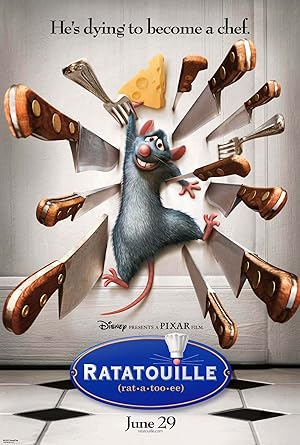
Ratatouille
A rat named Remy dreams of becoming a great French chef despite his family's wishes and the obvious problem of being a rat in a decidedly rodent-phobic profession. When fate places Remy in the sewers of Paris, he finds himself ideally situated beneath a restaurant made famous by his culinary hero, Auguste Gusteau. Despite the apparent dangers of being an unlikely, and certainly unwanted, visitor in the kitchen of a fine French restaurant, Remy's passion for cooking soon sets into motion a hilarious and exciting rat race that turns the culinary world of Paris upside down.
Despite a blockbuster budget of $150.0M, Ratatouille became a financial success, earning $623.7M worldwide—a 316% return. This commercial performance validated the ambitious narrative scope, showing that audiences embrace bold vision even at blockbuster scale.
1 Oscar. 68 wins & 42 nominations


Plot Structure
Story beats plotted across runtime


Narrative Arc
Emotional journey through the story's key moments
Story Circle
Blueprint 15-beat structure
Arcplot Score Breakdown
Weighted: Precision (70%) + Arc (15%) + Theme (15%)
Ratatouille (2007) showcases strategically placed narrative design, characteristic of Brad Bird's storytelling approach. This structural analysis examines how the film's 15-point plot structure maps to proven narrative frameworks across 1 hour and 51 minutes. With an Arcplot score of 2.9, the film takes an unconventional approach to traditional narrative frameworks.
Characters
Cast & narrative archetypes

Remy
Alfredo Linguini
Colette Tatou
Anton Ego
Chef Skinner
Auguste Gusteau
Django
Emile
Main Cast & Characters
Remy
Played by Patton Oswalt
A rat with exceptional taste and smell who dreams of becoming a chef despite his family's objections.
Alfredo Linguini
Played by Lou Romano
A clumsy garbage boy at Gusteau's restaurant who becomes a chef with Remy's secret help.
Colette Tatou
Played by Janeane Garofalo
The only female chef at Gusteau's, tough and skilled, who initially resents Linguini but becomes his mentor and love interest.
Anton Ego
Played by Peter O'Toole
France's most feared food critic whose negative review can destroy a restaurant, haunted by childhood memories of his mother's cooking.
Chef Skinner
Played by Ian Holm
The short-tempered head chef of Gusteau's who is exploiting the restaurant's name for frozen food products.
Auguste Gusteau
Played by Brad Garrett
The late celebrity chef whose spirit guides Remy, representing the philosophy that "anyone can cook."
Django
Played by Brian Dennehy
Remy's father and leader of the rat colony who wants his son to accept their lot in life and avoid humans.
Emile
Played by Peter Sohn
Remy's gluttonous older brother who doesn't understand Remy's refined palate but loyally supports him.
Structural Analysis
The Status Quo at 1 minutes (1% through the runtime) establishes Remy narrates his extraordinary sense of smell and taste, living in the French countryside with his rat colony, sneaking away to watch Gusteau's cooking show while his family scavenges garbage.. Notably, this early placement immediately immerses viewers in the story world.
The inciting incident occurs at 12 minutes when The old woman discovers Remy and Emile in her kitchen and opens fire with a shotgun, forcing the entire rat colony to evacuate; Remy is separated from his family in the chaos and swept away through the sewers.. At 11% through the film, this Disruption aligns precisely with traditional story structure. This beat shifts the emotional landscape, launching the protagonist into the central conflict.
The First Threshold at 24 minutes marks the transition into Act II, occurring at 22% of the runtime. This indicates the protagonist's commitment to Remy makes the active choice to jump down and fix the soup despite the danger, adding ingredients to repair Linguini's mistake; he's caught by Linguini, and Skinner forces Linguini to keep the rat to recreate the soup., moving from reaction to action.
At 50 minutes, the Midpoint arrives at 45% of the runtime—arriving early, accelerating into Act IIb complications. Significantly, this crucial beat False victory: Linguini learns he's Gusteau's son and inherits the restaurant; he and Remy are on top of the world; but Skinner vows revenge, and Ego announces he'll review the restaurant - raising the stakes enormously., fundamentally raising what's at risk. The emotional intensity shifts, dividing the narrative into clear before-and-after phases.
The Collapse moment at 74 minutes (67% through) represents the emotional nadir. Here, Remy, hurt by Linguini's dismissiveness, leads the rat colony to raid the restaurant's pantry; Linguini catches them and angrily banishes Remy; their partnership and friendship die, just as Ego arrives for his review., indicates the protagonist at their lowest point. This beat's placement in the final quarter sets up the climactic reversal.
The Second Threshold at 80 minutes initiates the final act resolution at 72% of the runtime. Remy chooses to return and help Linguini despite the betrayal; Colette returns after re-reading Gusteau's book about courage and innovation; Remy leads his entire colony into the kitchen to cook for Ego - synthesis of both worlds., demonstrating the transformation achieved throughout the journey.
Emotional Journey
Ratatouille's emotional architecture traces a deliberate progression across 15 carefully calibrated beats.
Narrative Framework
This structural analysis employs systematic plot point analysis that identifies crucial turning points. By mapping Ratatouille against these established plot points, we can identify how Brad Bird utilizes or subverts traditional narrative conventions. The plot point approach reveals not only adherence to structural principles but also creative choices that distinguish Ratatouille within the animation genre.
Brad Bird's Structural Approach
Among the 6 Brad Bird films analyzed on Arcplot, the average structural score is 5.6, showcasing experimental approaches to narrative form. Ratatouille takes a more unconventional approach compared to the director's typical style. For comparative analysis, explore the complete Brad Bird filmography.
Comparative Analysis
Additional animation films include The Bad Guys, Puss in Boots and Violet Evergarden: Eternity and the Auto Memory Doll. For more Brad Bird analyses, see Mission: Impossible - Ghost Protocol, The Incredibles and Incredibles 2.
Plot Points by Act
Act I
SetupStatus Quo
Remy narrates his extraordinary sense of smell and taste, living in the French countryside with his rat colony, sneaking away to watch Gusteau's cooking show while his family scavenges garbage.
Theme
Gusteau (on TV) declares his philosophy: "Anyone can cook" - the thematic statement that Remy believes but the world will challenge, and which Ego will redefine by film's end.
Worldbuilding
Remy's life with the colony: his partnership with brother Emile, his role as poison-checker for his father Django, his secret visits to the old woman's kitchen to cook, and his obsession with Gusteau's cookbook establishes his divided identity.
Disruption
The old woman discovers Remy and Emile in her kitchen and opens fire with a shotgun, forcing the entire rat colony to evacuate; Remy is separated from his family in the chaos and swept away through the sewers.
Resistance
Alone in Paris, Remy hallucinates Gusteau (his imaginary mentor) who encourages him to be bold; he discovers he's above Gusteau's restaurant; he witnesses Linguini's disastrous soup accident and debates whether to fix it or flee.
Act II
ConfrontationFirst Threshold
Remy makes the active choice to jump down and fix the soup despite the danger, adding ingredients to repair Linguini's mistake; he's caught by Linguini, and Skinner forces Linguini to keep the rat to recreate the soup.
Mirror World
Linguini and Remy discover they can communicate through pantomime, then develop the hair-pulling control system; their partnership begins - the relationship that will embody the theme of collaboration across impossible boundaries.
Premise
The "promise of the premise": Remy controls Linguini like a puppet to cook, creating amazing dishes; Linguini becomes the star chef; they navigate the kitchen dynamics, Colette becomes Linguini's mentor/love interest, and the restaurant thrives.
Midpoint
False victory: Linguini learns he's Gusteau's son and inherits the restaurant; he and Remy are on top of the world; but Skinner vows revenge, and Ego announces he'll review the restaurant - raising the stakes enormously.
Opposition
Linguini's ego grows as he takes credit for Remy's cooking; Remy reunites with his family but feels torn; Django disapproves of Remy's human collaboration; tension builds between Remy and Linguini over recognition and control.
Collapse
Remy, hurt by Linguini's dismissiveness, leads the rat colony to raid the restaurant's pantry; Linguini catches them and angrily banishes Remy; their partnership and friendship die, just as Ego arrives for his review.
Crisis
Linguini confesses to the staff that a rat is the real chef; everyone abandons him except Colette; Remy watches from afar, conflicted; Django tells Remy to accept that humans and rats are enemies, but Remy can't abandon Linguini.
Act III
ResolutionSecond Threshold
Remy chooses to return and help Linguini despite the betrayal; Colette returns after re-reading Gusteau's book about courage and innovation; Remy leads his entire colony into the kitchen to cook for Ego - synthesis of both worlds.
Synthesis
The rats execute a flawless dinner service under Remy's direction; Remy prepares ratatouille for Ego, who is transported to childhood by the taste; Ego writes a magnificent review defending Remy, sacrificing his career; health inspector closes Gusteau's.
Transformation
Final image mirrors the opening: Remy narrates again, but now he's head chef at La Ratatouille (Ego's new bistro), cooking for humans and rats alike; he's found his identity, integrating both worlds rather than choosing one.