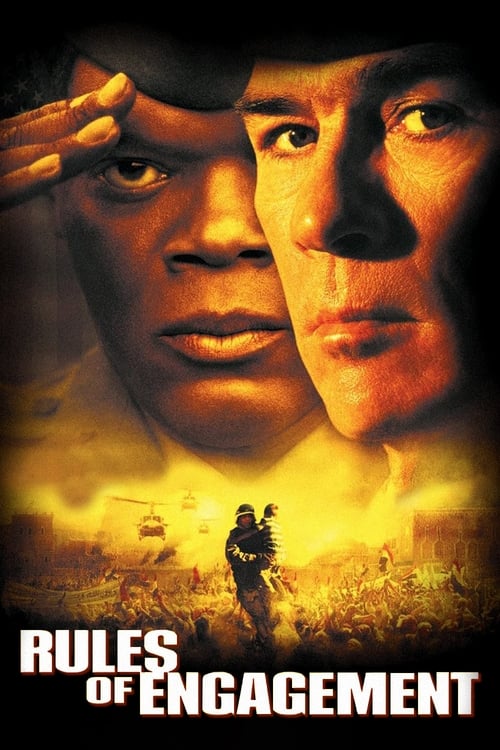
Rules of Engagement
A Marine Colonel is brought to court-martial after ordering his men to fire on demonstrators surrounding the American embassy in Yemen.
Working with a mid-range budget of $60.0M, the film achieved a respectable showing with $71.0M in global revenue (+18% profit margin).
1 win & 2 nominations


Plot Structure
Story beats plotted across runtime


Narrative Arc
Emotional journey through the story's key moments
Story Circle
Blueprint 15-beat structure
Arcplot Score Breakdown
Weighted: Precision (70%) + Arc (15%) + Theme (15%)
Rules of Engagement (2000) reveals strategically placed narrative architecture, characteristic of William Friedkin's storytelling approach. This structural analysis examines how the film's 15-point plot structure maps to proven narrative frameworks across 2 hours and 8 minutes. With an Arcplot score of 7.3, the film balances conventional beats with creative variation.
Characters
Cast & narrative archetypes

Colonel Terry Childers
Colonel Hayes Hodges
Major Mark Biggs
Ambassador Mourain
Captain Lee
National Security Advisor Bill Sokal
Major General Perry
Main Cast & Characters
Colonel Terry Childers
Played by Samuel L. Jackson
Marine colonel on trial for ordering fire on civilians during a Yemen embassy evacuation
Colonel Hayes Hodges
Played by Tommy Lee Jones
Retired Marine lawyer who defends his old friend Childers in court-martial proceedings
Major Mark Biggs
Played by Guy Pearce
Ambitious prosecutor determined to convict Childers for the Yemen incident
Ambassador Mourain
Played by Ben Kingsley
U.S. Ambassador to Yemen whose testimony becomes critical to the case
Captain Lee
Played by Blair Underwood
Marine captain who serves under Childers during the Yemen evacuation
National Security Advisor Bill Sokal
Played by Bruce Greenwood
Government official who manipulates evidence to protect political interests
Major General Perry
Played by Philip Baker Hall
Senior military officer overseeing the court-martial proceedings
Structural Analysis
The Status Quo at 1 minutes (1% through the runtime) establishes Vietnam 1968 flashback: Young Marines Childers and Hodges in combat. Childers saves Hodges' life by shooting an enemy soldier, establishing their bond and the theme of loyalty forged in war.. Notably, this early placement immediately immerses viewers in the story world.
The inciting incident occurs at 14 minutes when Childers is sent to Yemen to evacuate the U.S. Ambassador from the embassy during violent anti-American protests. The mission that will change everything begins.. At 11% through the film, this Disruption aligns precisely with traditional story structure. This beat shifts the emotional landscape, launching the protagonist into the central conflict.
The First Threshold at 31 minutes marks the transition into Act II, occurring at 24% of the runtime. This reveals the protagonist's commitment to Childers is charged with murder and orders of engagement violations. He asks Hodges to defend him at his court-martial, and Hodges reluctantly agrees out of loyalty. Hodges chooses to enter the legal battle world., moving from reaction to action.
At 65 minutes, the Midpoint arrives at 50% of the runtime—precisely centered, creating perfect narrative symmetry. Of particular interest, this crucial beat False defeat: The trial begins and early testimony goes badly for Childers. Ambassador Mourain, who Childers saved, testifies that he saw no weapons in the crowd, contradicting Childers' claim of armed hostiles. Hodges realizes evidence may have been destroyed., fundamentally raising what's at risk. The emotional intensity shifts, dividing the narrative into clear before-and-after phases.
The Collapse moment at 95 minutes (74% through) represents the emotional nadir. Here, Childers loses faith in the defense and in Hodges. He considers accepting a plea deal. Their friendship appears broken. Hodges hits his lowest point, facing failure and the loss of his closest friend., indicates the protagonist at their lowest point. This beat's placement in the final quarter sets up the climactic reversal.
The Second Threshold at 100 minutes initiates the final act resolution at 78% of the runtime. Breakthrough: Hodges realizes he must go to Yemen himself to find the truth. He discovers the missing surveillance tape evidence and witnesses who can confirm the crowd was armed. New information enables the final push., demonstrating the transformation achieved throughout the journey.
Emotional Journey
Rules of Engagement's emotional architecture traces a deliberate progression across 15 carefully calibrated beats.
Narrative Framework
This structural analysis employs systematic plot point analysis that identifies crucial turning points. By mapping Rules of Engagement against these established plot points, we can identify how William Friedkin utilizes or subverts traditional narrative conventions. The plot point approach reveals not only adherence to structural principles but also creative choices that distinguish Rules of Engagement within the war genre.
William Friedkin's Structural Approach
Among the 10 William Friedkin films analyzed on Arcplot, the average structural score is 7.2, reflecting strong command of classical structure. Rules of Engagement represents one of the director's most structurally precise works. For comparative analysis, explore the complete William Friedkin filmography.
Comparative Analysis
Additional war films include Fury, Shenandoah and More American Graffiti. For more William Friedkin analyses, see Cruising, Sorcerer and Jade.
Plot Points by Act
Act I
SetupStatus Quo
Vietnam 1968 flashback: Young Marines Childers and Hodges in combat. Childers saves Hodges' life by shooting an enemy soldier, establishing their bond and the theme of loyalty forged in war.
Theme
Hodges reflects on Vietnam: "Some things you do for your country, some things your country asks you to live with." The central question of moral accountability in following orders is stated.
Worldbuilding
Present day: Hodges is an aging, alcoholic military lawyer with a limp from Vietnam. Childers is a decorated Marine colonel. The film establishes their parallel lives since the war and Hodges' failed legal career.
Disruption
Childers is sent to Yemen to evacuate the U.S. Ambassador from the embassy during violent anti-American protests. The mission that will change everything begins.
Resistance
The Yemen rescue mission unfolds: Childers and his Marines arrive at the embassy under siege. After taking sniper fire, Childers orders his men to open fire on the crowd, resulting in 83 civilian deaths. The incident that will lead to his court-martial occurs.
Act II
ConfrontationFirst Threshold
Childers is charged with murder and orders of engagement violations. He asks Hodges to defend him at his court-martial, and Hodges reluctantly agrees out of loyalty. Hodges chooses to enter the legal battle world.
Mirror World
Hodges meets with Childers and learns the details of Yemen. Their friendship becomes the emotional core - Hodges must balance loyalty to his friend with his duty to seek truth and justice.
Premise
Courtroom drama premise: Hodges investigates the Yemen incident, interviews survivors, and prepares his defense. The prosecution builds its case that Childers murdered civilians. Hodges struggles with evidence that seems damning.
Midpoint
False defeat: The trial begins and early testimony goes badly for Childers. Ambassador Mourain, who Childers saved, testifies that he saw no weapons in the crowd, contradicting Childers' claim of armed hostiles. Hodges realizes evidence may have been destroyed.
Opposition
The prosecution intensifies with devastating testimony from wounded civilians and Marine witnesses. Hodges uncovers a conspiracy: the National Security Advisor ordered the removal of evidence (a surveillance tape) to protect political interests. The system is working against them.
Collapse
Childers loses faith in the defense and in Hodges. He considers accepting a plea deal. Their friendship appears broken. Hodges hits his lowest point, facing failure and the loss of his closest friend.
Crisis
Dark night: Hodges drinks alone, confronting his own failures and the seeming impossibility of winning. He must decide whether to give up or fight the system itself.
Act III
ResolutionSecond Threshold
Breakthrough: Hodges realizes he must go to Yemen himself to find the truth. He discovers the missing surveillance tape evidence and witnesses who can confirm the crowd was armed. New information enables the final push.
Synthesis
Final trial sequence: Hodges presents the surveillance tape showing armed protesters firing on the embassy. He aggressively cross-examines Ambassador Mourain, forcing him to admit the crowd was armed. He exposes the political cover-up. Childers testifies to his impossible choice under fire.
Transformation
Verdict: Not guilty. Childers is vindicated. Hodges and Childers salute each other, their bond restored. The closing image mirrors the opening: two Marines who fought for each other, but now with the added weight of moral complexity and truth served.