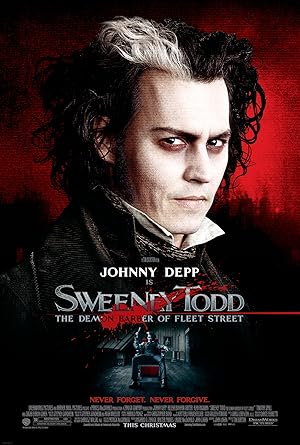
Sweeney Todd: The Demon Barber of Fleet Street
In the Victorian London, the barber Benjamin Barker is married to the gorgeous Lucy and they have a lovely child, Johanna. The beauty of Lucy attracts the attention of the corrupt Judge Turpin, who falsely accuses the barber of a crime that he did not commit and abuses Lucy later after gaining custody of her. After fifteen years in exile, Benjamin returns to London under the new identity of Sweeney Todd, seeking revenge against Turpin. He meets the widow Mrs. Lovett who is the owner of a meat pie shop who tells him that Lucy swallowed arsenic many years ago, and Turpin assigned himself tutor of Johanna. He opens a barber shop above her store, initiating a crime rampage against those who made him suffer and lose his beloved family.
Despite a mid-range budget of $50.0M, Sweeney Todd: The Demon Barber of Fleet Street became a box office success, earning $152.0M worldwide—a 204% return.
1 Oscar. 34 wins & 77 nominations


Plot Structure
Story beats plotted across runtime


Narrative Arc
Emotional journey through the story's key moments
Story Circle
Blueprint 15-beat structure
Arcplot Score Breakdown
Weighted: Precision (70%) + Arc (15%) + Theme (15%)
Sweeney Todd: The Demon Barber of Fleet Street (2007) reveals deliberately positioned narrative design, characteristic of Tim Burton's storytelling approach. This structural analysis examines how the film's 15-point plot structure maps to proven narrative frameworks across 1 hour and 56 minutes. With an Arcplot score of 6.8, the film balances conventional beats with creative variation.
Characters
Cast & narrative archetypes

Sweeney Todd
Mrs. Lovett
Judge Turpin
Anthony Hope
Johanna
Beadle Bamford
Adolfo Pirelli
Toby
Main Cast & Characters
Sweeney Todd
Played by Johnny Depp
A vengeful barber who returns to London after 15 years of wrongful imprisonment, seeking revenge against the judge who destroyed his life.
Mrs. Lovett
Played by Helena Bonham Carter
A resourceful pie shop owner who harbors unrequited love for Sweeney and becomes his accomplice in murder.
Judge Turpin
Played by Alan Rickman
A corrupt and lecherous judge who destroyed Sweeney's former life and adopted his daughter as his ward.
Anthony Hope
Played by Jamie Campbell Bower
A young, idealistic sailor who falls in love with Johanna and seeks to rescue her from Judge Turpin.
Johanna
Played by Jayne Wisener
Sweeney Todd's daughter, kept as a virtual prisoner by Judge Turpin who plans to marry her.
Beadle Bamford
Played by Timothy Spall
Judge Turpin's corrupt right-hand man who enforces the judge's will and takes bribes.
Adolfo Pirelli
Played by Sacha Baron Cohen
A flamboyant, fraudulent barber who competes with Sweeney and attempts to blackmail him.
Toby
Played by Ed Sanders
A young orphan boy who works as Pirelli's assistant and later becomes fiercely loyal to Mrs. Lovett.
Structural Analysis
The Status Quo at 1 minutes (1% through the runtime) establishes A ship emerges from fog as Sweeney Todd returns to London after fifteen years of wrongful imprisonment, singing "No Place Like London" with sailor Anthony Hope. The dark, oppressive imagery establishes a world of shadows and vengeance.. Structural examination shows that this early placement immediately immerses viewers in the story world.
The inciting incident occurs at 14 minutes when Mrs. Lovett reveals she kept Todd's old razors hidden and returns them to him. Holding his "friends" again, Todd commits to vengeance: "At last my arm is complete again." His identity as Benjamin Barker dies and Sweeney Todd is truly born.. At 12% through the film, this Disruption aligns precisely with traditional story structure. This beat shifts the emotional landscape, launching the protagonist into the central conflict.
The First Threshold at 29 minutes marks the transition into Act II, occurring at 25% of the runtime. This reveals the protagonist's commitment to Todd slits Pirelli's throat with his razor - his first kill. This irreversible act transforms him from a wronged man seeking justice to a murderer. Mrs. Lovett becomes his accomplice by helping dispose of the body and taking in Pirelli's young assistant Toby., moving from reaction to action.
At 58 minutes, the Midpoint arrives at 50% of the runtime—precisely centered, creating perfect narrative symmetry. Of particular interest, this crucial beat The pie shop becomes wildly successful ("God That's Good!"). Mrs. Lovett's dreams of domesticity with Todd and Toby seem within reach. This false victory masks the horror: Todd has become a serial killer, and their prosperity is built on human flesh. The stakes have transformed from personal revenge to industrial murder., fundamentally raising what's at risk. The emotional intensity shifts, dividing the narrative into clear before-and-after phases.
The Collapse moment at 87 minutes (75% through) represents the emotional nadir. Here, Toby discovers the truth about the meat pies and flees into the sewers. Mrs. Lovett locks him in the bakehouse, but the boy now knows everything. Their entire operation is compromised. The walls close in as Todd's grand revenge scheme threatens to unravel before he can kill the Judge., demonstrates the protagonist at their lowest point. This beat's placement in the final quarter sets up the climactic reversal.
The Second Threshold at 93 minutes initiates the final act resolution at 80% of the runtime. Judge Turpin arrives at the barbershop seeking a shave before his wedding to Johanna. Todd finally has his enemy in the chair. The moment of vengeance he has waited fifteen years for is at hand. He commits fully to ending this, singing a dark reprise as he prepares the kill., demonstrating the transformation achieved throughout the journey.
Emotional Journey
Sweeney Todd: The Demon Barber of Fleet Street's emotional architecture traces a deliberate progression across 15 carefully calibrated beats.
Narrative Framework
This structural analysis employs proven narrative structure principles that track dramatic progression. By mapping Sweeney Todd: The Demon Barber of Fleet Street against these established plot points, we can identify how Tim Burton utilizes or subverts traditional narrative conventions. The plot point approach reveals not only adherence to structural principles but also creative choices that distinguish Sweeney Todd: The Demon Barber of Fleet Street within the drama genre.
Tim Burton's Structural Approach
Among the 19 Tim Burton films analyzed on Arcplot, the average structural score is 6.9, demonstrating varied approaches to story architecture. Sweeney Todd: The Demon Barber of Fleet Street takes a more unconventional approach compared to the director's typical style. For comparative analysis, explore the complete Tim Burton filmography.
Comparative Analysis
Additional drama films include After Thomas, South Pacific and Dirty Dancing: Havana Nights. For more Tim Burton analyses, see Beetlejuice, Dark Shadows and Pee-wee's Big Adventure.
Plot Points by Act
Act I
SetupStatus Quo
A ship emerges from fog as Sweeney Todd returns to London after fifteen years of wrongful imprisonment, singing "No Place Like London" with sailor Anthony Hope. The dark, oppressive imagery establishes a world of shadows and vengeance.
Theme
Todd declares "There's a hole in the world like a great black pit and it's filled with people who are filled with shit" - establishing the nihilistic worldview that will justify his eventual mass murder. The theme of universal corruption is stated.
Worldbuilding
Todd arrives in London and enters Mrs. Lovett's meat pie shop on Fleet Street. She reveals his tragic backstory: as Benjamin Barker, he had a beautiful wife Lucy and daughter Johanna until Judge Turpin falsely imprisoned him to steal his wife. Lucy poisoned herself and Johanna became Turpin's ward.
Disruption
Mrs. Lovett reveals she kept Todd's old razors hidden and returns them to him. Holding his "friends" again, Todd commits to vengeance: "At last my arm is complete again." His identity as Benjamin Barker dies and Sweeney Todd is truly born.
Resistance
Todd reopens his barber shop above Mrs. Lovett's. He faces Pirelli, a rival barber, in a shaving contest and wins. Anthony discovers Johanna imprisoned in Judge Turpin's house and falls instantly in love. Pirelli recognizes Todd and attempts blackmail, becoming Todd's first murder victim.
Act II
ConfrontationFirst Threshold
Todd slits Pirelli's throat with his razor - his first kill. This irreversible act transforms him from a wronged man seeking justice to a murderer. Mrs. Lovett becomes his accomplice by helping dispose of the body and taking in Pirelli's young assistant Toby.
Mirror World
Anthony sings "Johanna" as he watches her from the street - pure, romantic love presented as the thematic counterpoint to Todd's consuming hatred. Their innocent love story represents what Todd lost and what his vengeance threatens to destroy.
Premise
Todd lures Judge Turpin to his shop but is interrupted by Anthony before he can kill him. Frustrated, Todd expands his mission: "We all deserve to die" becomes his creed. Mrs. Lovett proposes using his victims as filling for her meat pies - "A Little Priest" - and their macabre business partnership flourishes.
Midpoint
The pie shop becomes wildly successful ("God That's Good!"). Mrs. Lovett's dreams of domesticity with Todd and Toby seem within reach. This false victory masks the horror: Todd has become a serial killer, and their prosperity is built on human flesh. The stakes have transformed from personal revenge to industrial murder.
Opposition
Judge Turpin decides to marry Johanna himself, accelerating Anthony's rescue plan. Toby grows suspicious of Todd and the basement's secrets. The Beadle investigates complaints about the bakehouse smell. Todd's obsession blinds him to the net closing around them as Mrs. Lovett desperately tries to maintain their facade.
Collapse
Toby discovers the truth about the meat pies and flees into the sewers. Mrs. Lovett locks him in the bakehouse, but the boy now knows everything. Their entire operation is compromised. The walls close in as Todd's grand revenge scheme threatens to unravel before he can kill the Judge.
Crisis
Todd becomes increasingly desperate and unhinged. Anthony and Johanna prepare their escape while Todd waits for his final chance at the Judge. The Beggar Woman, who has been haunting the shop, grows more persistent, sensing something terrible. All storylines converge toward the bloody climax.
Act III
ResolutionSecond Threshold
Judge Turpin arrives at the barbershop seeking a shave before his wedding to Johanna. Todd finally has his enemy in the chair. The moment of vengeance he has waited fifteen years for is at hand. He commits fully to ending this, singing a dark reprise as he prepares the kill.
Synthesis
Todd slashes the Beggar Woman's throat when she interrupts, then finally kills Judge Turpin and the Beadle. Anthony rescues Johanna. In the bakehouse, Todd discovers the Beggar Woman was Lucy - his wife, driven mad but alive. Mrs. Lovett lied. In grief and rage, Todd throws Mrs. Lovett into her own oven, then cradles Lucy's body as Toby emerges and slits Todd's throat.
Transformation
Todd dies holding Lucy's body, their blood mingling on the bakehouse floor. His revenge is complete but meaningless - he killed his own wife in his blind obsession. The final image mirrors the opening darkness: a man destroyed by the very vengeance he sought, having become worse than those he blamed.