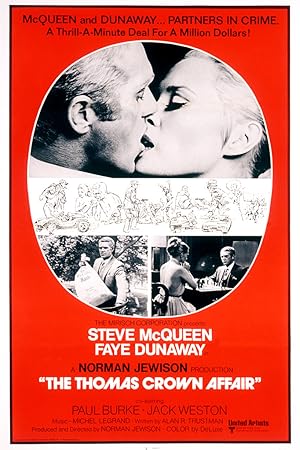
The Thomas Crown Affair
Four men pull off a daring daytime robbery at a bank, dump the money in a trash can and go their separate ways. Thomas Crown, a successful, wealthy businessman pulls up in his Rolls and collects it. Vickie Anderson, an independent insurance investigator is called in to recover the huge haul. She begins to examine the people who knew enough about the bank to have pulled the robbery and discovers Crown. She begins a tight watch on his every move and begins seeing him socially. How does the planner of the perfect crime react to pressure?
Despite its small-scale budget of $4.3M, The Thomas Crown Affair became a financial success, earning $14.0M worldwide—a 226% return. The film's compelling narrative engaged audiences, illustrating how strong storytelling can transcend budget limitations.
1 Oscar. 2 wins & 5 nominations


Plot Structure
Story beats plotted across runtime


Narrative Arc
Emotional journey through the story's key moments
Story Circle
Blueprint 15-beat structure
Arcplot Score Breakdown
Weighted: Precision (70%) + Arc (15%) + Theme (15%)
The Thomas Crown Affair (1968) reveals precise narrative design, characteristic of Norman Jewison's storytelling approach. This structural analysis examines how the film's 15-point plot structure maps to proven narrative frameworks across 1 hour and 42 minutes. With an Arcplot score of 7.3, the film balances conventional beats with creative variation.
Characters
Cast & narrative archetypes

Thomas Crown
Vicki Anderson
Eddy Malone
Main Cast & Characters
Thomas Crown
Played by Steve McQueen
A wealthy, sophisticated businessman who orchestrates a bank heist for the thrill, playing a dangerous cat-and-mouse game with an insurance investigator.
Vicki Anderson
Played by Faye Dunaway
A sharp, independent insurance investigator hired to recover the stolen money, who becomes romantically entangled with her prime suspect.
Eddy Malone
Played by Paul Burke
A persistent police detective investigating the bank robbery, frustrated by Crown's cleverness and Vicki's interference.
Structural Analysis
The Status Quo at 1 minutes (1% through the runtime) establishes Thomas Crown orchestrates a meticulously planned bank robbery from afar, directing multiple hired criminals via coordinated timing. He observes from his Rolls Royce, uninvolved yet completely in control—a wealthy man playing dangerous games for thrills, not money.. Significantly, this early placement immediately immerses viewers in the story world.
The inciting incident occurs at 12 minutes when Vicki Anderson, an independent insurance investigator, arrives to solve the case. Sharp, beautiful, and equally as calculating as Crown, she represents something he hasn't encountered: a worthy opponent who could expose him—and potentially truly see him.. At 12% through the film, this Disruption aligns precisely with traditional story structure. This beat shifts the emotional landscape, launching the protagonist into the central conflict.
The First Threshold at 26 minutes marks the transition into Act II, occurring at 25% of the runtime. This reveals the protagonist's commitment to Crown actively chooses to pursue Vicki romantically despite the danger. He invites her to his estate, beginning an elaborate seduction. This choice launches him into Act 2—a game where the stakes are his freedom and, unexpectedly, his heart., moving from reaction to action.
At 52 minutes, the Midpoint arrives at 51% of the runtime—precisely centered, creating perfect narrative symmetry. Of particular interest, this crucial beat Vicki definitively concludes Crown is guilty. She lays out her theory to him directly in a confrontation. False defeat for Crown: she knows, but can't prove it. The game intensifies—stakes shift from intellectual exercise to genuine emotional consequences., fundamentally raising what's at risk. The emotional intensity shifts, dividing the narrative into clear before-and-after phases.
The Collapse moment at 76 minutes (75% through) represents the emotional nadir. Here, Crown's carefully controlled world crumbles. Vicki presents an ultimatum: she loves him but won't be with a criminal. She gives him a chance to return the money and start clean. The "whiff of death"—his perfect, controlled existence must die for real connection to live., illustrates the protagonist at their lowest point. This beat's placement in the final quarter sets up the climactic reversal.
The Second Threshold at 82 minutes initiates the final act resolution at 81% of the runtime. Crown devises a final plan: he'll return the money publicly, clearing himself while proving his love to Vicki. He arranges to meet her at the airport, asking her to leave the country with him. The synthesis—combine his cleverness with newfound emotional authenticity., demonstrating the transformation achieved throughout the journey.
Emotional Journey
The Thomas Crown Affair's emotional architecture traces a deliberate progression across 15 carefully calibrated beats.
Narrative Framework
This structural analysis employs proven narrative structure principles that track dramatic progression. By mapping The Thomas Crown Affair against these established plot points, we can identify how Norman Jewison utilizes or subverts traditional narrative conventions. The plot point approach reveals not only adherence to structural principles but also creative choices that distinguish The Thomas Crown Affair within the crime genre.
Norman Jewison's Structural Approach
Among the 13 Norman Jewison films analyzed on Arcplot, the average structural score is 7.2, reflecting strong command of classical structure. The Thomas Crown Affair represents one of the director's most structurally precise works. For comparative analysis, explore the complete Norman Jewison filmography.
Comparative Analysis
Additional crime films include The Bad Guys, Rustom and The Whole Ten Yards. For more Norman Jewison analyses, see A Soldier's Story, ...And Justice for All and F.I.S.T..
Plot Points by Act
Act I
SetupStatus Quo
Thomas Crown orchestrates a meticulously planned bank robbery from afar, directing multiple hired criminals via coordinated timing. He observes from his Rolls Royce, uninvolved yet completely in control—a wealthy man playing dangerous games for thrills, not money.
Theme
Crown's associate comments on his lifestyle: "You have everything." Crown's response reveals emptiness behind the wealth. The theme: What do you do when you have everything but feel nothing? Can genuine connection penetrate a perfectly controlled life?
Worldbuilding
Establish Crown's world of privilege: polo matches, board meetings, elegant parties, his businessman facade. The bank heist succeeds flawlessly, netting $2.6 million. Police investigate but have no leads. Crown maintains perfect deniability, living his double life.
Disruption
Vicki Anderson, an independent insurance investigator, arrives to solve the case. Sharp, beautiful, and equally as calculating as Crown, she represents something he hasn't encountered: a worthy opponent who could expose him—and potentially truly see him.
Resistance
Vicki investigates, immediately suspecting Crown based on profile and instinct. Crown becomes aware of her investigation. Instead of fleeing or backing away, he's intrigued. They meet, beginning a cat-and-mouse game of seduction and detection.
Act II
ConfrontationFirst Threshold
Crown actively chooses to pursue Vicki romantically despite the danger. He invites her to his estate, beginning an elaborate seduction. This choice launches him into Act 2—a game where the stakes are his freedom and, unexpectedly, his heart.
Mirror World
The romantic relationship deepens through iconic scenes: chess in the study, glider flying, beach encounters. Vicki represents the thematic mirror—she's his equal in intelligence and control, but she works within the system. She offers connection if he'll surrender his games.
Premise
The promise of the premise: an elegant thriller of seduction and detection. Crown and Vicki engage in elaborate mental chess. Romantic montages (including the famous chess scene) alternate with investigation tension. Each tries to outmaneuver the other while falling deeper.
Midpoint
Vicki definitively concludes Crown is guilty. She lays out her theory to him directly in a confrontation. False defeat for Crown: she knows, but can't prove it. The game intensifies—stakes shift from intellectual exercise to genuine emotional consequences.
Opposition
Pressure mounts from multiple directions. Police investigation continues. Vicki's employer demands results. Crown realizes he's genuinely falling for Vicki, complicating his control. One of the robbers becomes a liability. Crown must decide: the perfect crime or the imperfect woman?
Collapse
Crown's carefully controlled world crumbles. Vicki presents an ultimatum: she loves him but won't be with a criminal. She gives him a chance to return the money and start clean. The "whiff of death"—his perfect, controlled existence must die for real connection to live.
Crisis
Crown faces his dark night: surrender control and accept love, or maintain his perfect crime and perfect isolation? He processes whether connection is worth vulnerability. Vicki waits, uncertain if he's capable of choosing her over the game.
Act III
ResolutionSecond Threshold
Crown devises a final plan: he'll return the money publicly, clearing himself while proving his love to Vicki. He arranges to meet her at the airport, asking her to leave the country with him. The synthesis—combine his cleverness with newfound emotional authenticity.
Synthesis
The finale unfolds at the airport. Crown orchestrates the return of the money through an elaborate ruse that maintains his deniability. He waits for Vicki at the gate, uncertain if she'll come. The question: has he truly changed, or is this another manipulation?
Transformation
Vicki doesn't board the plane. Crown flies away alone, returning to his world of control and isolation. The transformation is ambiguous—he offered love but perhaps not surrender. She chose integrity over passion. Both return to their status quo, changed yet unchanged. A sophisticated tragedy of two people too controlled to risk everything.