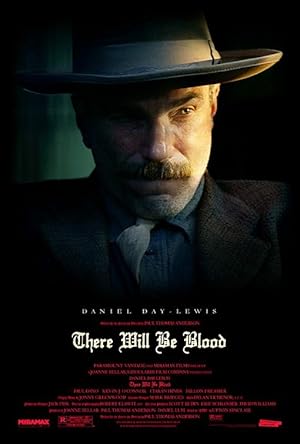
There Will Be Blood
The intersecting life stories of Daniel Plainview and Eli Sunday in early twentieth century California is presented. Miner turn oilman Daniel Plainview is a driven man who will do whatever it takes to achieve his goals. He works hard but he also takes advantage of those around him at their expense if need be. His business partner is his son H.W., who in reality he "acquired" when H.W.'s biological single father, who worked on one of Daniel's rigs, got killed in a workplace accident. Daniel is deeply protective of H.W. if only for what H.W. brings to the partnership. Eli Sunday is one in a pair of twins, whose family farm Daniel purchases for the major oil deposit located on it. Eli, the local preacher and a self-proclaimed faith healer, wants the money from the sale of the property to finance his own church. The lives of the two competitive men often clash as Daniel pumps oil off the property and tries to acquire all the surrounding land at bargain prices to be able to build a pipeline to the coast, and as Eli tries to build his own religious empire.
Despite a respectable budget of $25.0M, There Will Be Blood became a box office success, earning $77.2M worldwide—a 209% return.
2 Oscars. 114 wins & 138 nominations
Roger Ebert
"Anderson has created an epic about greed and power that feels like a novel from another era, with Day-Lewis delivering one of cinema's great performances."Read Full Review


Plot Structure
Story beats plotted across runtime


Narrative Arc
Emotional journey through the story's key moments
Story Circle
Blueprint 15-beat structure
Arcplot Score Breakdown
Weighted: Precision (70%) + Arc (15%) + Theme (15%)
There Will Be Blood (2007) showcases carefully calibrated plot construction, characteristic of Paul Thomas Anderson's storytelling approach. This structural analysis examines how the film's 15-point plot structure maps to proven narrative frameworks across 2 hours and 38 minutes. With an Arcplot score of 3.1, the film takes an unconventional approach to traditional narrative frameworks.
Characters
Cast & narrative archetypes

Daniel Plainview
Eli Sunday
H.W. Plainview
Henry Brands
Main Cast & Characters
Daniel Plainview
Played by Daniel Day-Lewis
A ruthless oilman whose ambition and misanthropy lead to wealth and isolation
Eli Sunday
Played by Paul Dano
A charismatic young preacher who becomes Plainview's ideological and territorial rival
H.W. Plainview
Played by Dillon Freasier
Daniel's adopted son who loses his hearing in an oil derrick explosion
Henry Brands
Played by Kevin J. O'Connor
A man claiming to be Daniel's half-brother who briefly joins the operation
Structural Analysis
The Status Quo at 1 minutes (1% through the runtime) establishes Daniel Plainview toils alone in a dark mine shaft, a solitary prospector driven by raw ambition and brutal self-reliance. The wordless opening establishes his isolation and relentless drive for wealth.. The analysis reveals that this early placement immediately immerses viewers in the story world.
The inciting incident occurs at 17 minutes when Paul Sunday arrives and sells Daniel information about an ocean of oil beneath his family's ranch in Little Boston for $500. This tip sets Daniel on his collision course with the Sunday family.. At 11% through the film, this Disruption aligns precisely with traditional story structure. This beat shifts the emotional landscape, launching the protagonist into the central conflict.
The First Threshold at 36 minutes marks the transition into Act II, occurring at 22% of the runtime. This reveals the protagonist's commitment to Daniel acquires the Sunday ranch and surrounding properties, committing fully to the Little Boston venture. He breaks ground on the well, irrevocably tying his fate to this land and its people., moving from reaction to action.
At 71 minutes, the Midpoint arrives at 45% of the runtime—arriving early, accelerating into Act IIb complications. Structural examination shows that this crucial beat Henry, claiming to be Daniel's half-brother, arrives. Daniel's desperate embrace of this stranger reveals the depth of his loneliness—a false victory as he believes he's found family, but Henry is an impostor exploiting his need for connection., fundamentally raising what's at risk. The emotional intensity shifts, dividing the narrative into clear before-and-after phases.
The Collapse moment at 107 minutes (67% through) represents the emotional nadir. Here, Daniel undergoes baptism in Eli's church, forced to scream "I have abandoned my child!" while Eli slaps him repeatedly. His complete humiliation before the community represents the death of his pride and any remaining humanity., shows the protagonist at their lowest point. This beat's placement in the final quarter sets up the climactic reversal.
The Second Threshold at 114 minutes initiates the final act resolution at 72% of the runtime. Years later, H.W. Returns as an adult to tell Daniel he's starting his own oil company with his wife. Daniel, drunk and vicious, disowns H.W., revealing he was never his real son—just "a bastard from a basket." He chooses complete isolation., demonstrating the transformation achieved throughout the journey.
Emotional Journey
There Will Be Blood's emotional architecture traces a deliberate progression across 15 carefully calibrated beats.
Narrative Framework
This structural analysis employs structural analysis methodology used to understand storytelling architecture. By mapping There Will Be Blood against these established plot points, we can identify how Paul Thomas Anderson utilizes or subverts traditional narrative conventions. The plot point approach reveals not only adherence to structural principles but also creative choices that distinguish There Will Be Blood within the drama genre.
Paul Thomas Anderson's Structural Approach
Among the 8 Paul Thomas Anderson films analyzed on Arcplot, the average structural score is 6.6, demonstrating varied approaches to story architecture. There Will Be Blood takes a more unconventional approach compared to the director's typical style. For comparative analysis, explore the complete Paul Thomas Anderson filmography.
Comparative Analysis
Additional drama films include After Thomas, South Pacific and Dirty Dancing: Havana Nights. For more Paul Thomas Anderson analyses, see Magnolia, Phantom Thread and Licorice Pizza.
Plot Points by Act
Act I
SetupStatus Quo
Daniel Plainview toils alone in a dark mine shaft, a solitary prospector driven by raw ambition and brutal self-reliance. The wordless opening establishes his isolation and relentless drive for wealth.
Theme
Daniel tells potential investors, "I have a competition in me. I want no one else to succeed." This confession reveals the corrosive ambition that will destroy everything he touches.
Worldbuilding
We witness Daniel's rise from solitary miner to oil prospector, his adoption of orphaned H.W. after a worker's death, and his calculated use of the boy as a prop to appear as a "family man" to landowners.
Disruption
Paul Sunday arrives and sells Daniel information about an ocean of oil beneath his family's ranch in Little Boston for $500. This tip sets Daniel on his collision course with the Sunday family.
Resistance
Daniel travels to Little Boston, surveys the Sunday ranch, and negotiates with Abel Sunday for the land. He encounters Eli Sunday, the young preacher, who demands money for his Church of the Third Revelation—establishing their adversarial relationship.
Act II
ConfrontationFirst Threshold
Daniel acquires the Sunday ranch and surrounding properties, committing fully to the Little Boston venture. He breaks ground on the well, irrevocably tying his fate to this land and its people.
Mirror World
Eli Sunday emerges as Daniel's spiritual antagonist, demanding the blessing ceremony Daniel promised. Their battle for the soul of Little Boston begins—commerce versus faith, each man using the community for his own ends.
Premise
Daniel builds his oil empire, the derrick rises, and oil flows. But an explosion deafens H.W., revealing the cost of Daniel's obsession. He humiliates Eli by denying him the blessing ceremony, and we watch his wealth grow alongside his isolation.
Midpoint
Henry, claiming to be Daniel's half-brother, arrives. Daniel's desperate embrace of this stranger reveals the depth of his loneliness—a false victory as he believes he's found family, but Henry is an impostor exploiting his need for connection.
Opposition
Daniel sends the deaf H.W. away to a school, choosing oil over his son. He discovers Henry's deception and murders him. To secure a pipeline through Bandy's land, Daniel must publicly submit to Eli's humiliating baptism, confessing he abandoned his child.
Collapse
Daniel undergoes baptism in Eli's church, forced to scream "I have abandoned my child!" while Eli slaps him repeatedly. His complete humiliation before the community represents the death of his pride and any remaining humanity.
Crisis
Daniel sits in darkness after the baptism, consumed by hatred. The pipeline deal is secured, but at the cost of his soul. Time passes—we see him wealthy beyond measure but utterly alone, drinking in his mansion's bowling alley.
Act III
ResolutionSecond Threshold
Years later, H.W. returns as an adult to tell Daniel he's starting his own oil company with his wife. Daniel, drunk and vicious, disowns H.W., revealing he was never his real son—just "a bastard from a basket." He chooses complete isolation.
Synthesis
Eli Sunday, now a failed radio evangelist, comes to Daniel's mansion seeking money for a drilling deal. Daniel forces Eli to renounce his faith, screaming "I am a false prophet, God is a superstition!" Then reveals he's already drained the oil—"I drink your milkshake!"
Transformation
Daniel bludgeons Eli to death with a bowling pin in his private alley. When his butler arrives, Daniel declares "I'm finished." The man who began alone in a hole ends alone in a palace, having destroyed everything and everyone.