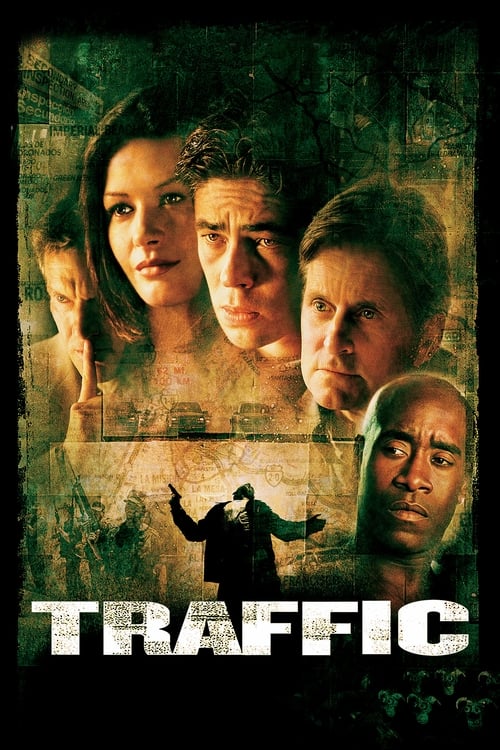
Traffic
An exploration of the United States of America's war on drugs from multiple perspectives. For the new head of the Office of National Drug Control Policy, the war becomes personal when he discovers his well-educated daughter is abusing cocaine within their comfortable suburban home. In Mexico, a flawed, but noble policeman agrees to testify against a powerful general in league with a cartel, and in San Diego, a drug kingpin's sheltered trophy wife must learn her husband's ruthless business after he is arrested, endangering her luxurious lifestyle.
Despite a respectable budget of $48.0M, Traffic became a solid performer, earning $207.5M worldwide—a 332% return.
4 Oscars. 73 wins & 86 nominations


Plot Structure
Story beats plotted across runtime


Narrative Arc
Emotional journey through the story's key moments
Story Circle
Blueprint 15-beat structure
Arcplot Score Breakdown
Weighted: Precision (70%) + Arc (15%) + Theme (15%)
Traffic (2000) showcases deliberately positioned dramatic framework, characteristic of Steven Soderbergh's storytelling approach. This structural analysis examines how the film's 15-point plot structure maps to proven narrative frameworks across 2 hours and 27 minutes. With an Arcplot score of 7.4, the film balances conventional beats with creative variation.
Characters
Cast & narrative archetypes

Robert Wakefield
Javier Rodriguez
Helena Ayala
Caroline Wakefield
Montel Gordon
Ray Castro
General Salazar
Barbara Wakefield
Main Cast & Characters
Robert Wakefield
Played by Michael Douglas
Ohio Supreme Court judge appointed as national drug czar who discovers his daughter is addicted to drugs
Javier Rodriguez
Played by Benicio del Toro
Principled Mexican police officer fighting corruption and cartels in Tijuana
Helena Ayala
Played by Catherine Zeta-Jones
Wealthy housewife who takes over her husband's drug empire when he's arrested
Caroline Wakefield
Played by Erika Christensen
Honor student whose descent into drug addiction exposes her father's war on drugs as deeply personal
Montel Gordon
Played by Don Cheadle
DEA agent working to build case against San Diego drug traffickers
Ray Castro
Played by Luis Guzmán
DEA agent partnered with Gordon investigating the Ayala organization
General Salazar
Played by Tomás Milián
Mexican military general who appears to fight drugs but is actually protecting the Tijuana cartel
Barbara Wakefield
Played by Amy Irving
Robert's wife who struggles to connect with her daughter and husband
Structural Analysis
The Status Quo at 1 minutes (1% through the runtime) establishes In the sepia-toned Mexican desert, Javier Rodriguez and Manolo Sanchez stake out drug runners, establishing the gritty reality of the drug trade at its source. Simultaneously, we see the Wakefield family's comfortable upper-class existence in Ohio, unaware of the storm approaching.. Structural examination shows that this early placement immediately immerses viewers in the story world.
The inciting incident occurs at 18 minutes when Carlos Ayala is arrested in front of his home, shattering Helena's illusion of legitimate wealth. Simultaneously, Wakefield accepts the Drug Czar position while oblivious to his daughter Caroline's escalating drug use with her boyfriend Seth. The comfortable facades of the American Dream begin cracking.. At 12% through the film, this Disruption aligns precisely with traditional story structure. This beat shifts the emotional landscape, launching the protagonist into the central conflict.
The First Threshold at 37 minutes marks the transition into Act II, occurring at 25% of the runtime. This shows the protagonist's commitment to Three irreversible commitments occur: Wakefield publicly declares aggressive anti-drug policies as the new Drug Czar. Helena discovers the true extent of Carlos's drug empire and chooses to protect the business rather than cooperate with authorities. Javier realizes Salazar is working for the Juarez cartel and must decide whether to become complicit or resist., moving from reaction to action.
At 74 minutes, the Midpoint arrives at 50% of the runtime—precisely centered, creating perfect narrative symmetry. The analysis reveals that this crucial beat Multiple revelations shatter false hopes. Wakefield finally discovers Caroline is addicted to cocaine and heroin—his war on drugs has failed in his own home. Helena learns the cartel has ordered a hit on the witness against Carlos, forcing her to become an active criminal. Javier's partner Manolo is revealed to be working with General Salazar, leaving Javier completely isolated. The game fundamentally changes for everyone., fundamentally raising what's at risk. The emotional intensity shifts, dividing the narrative into clear before-and-after phases.
The Collapse moment at 110 minutes (75% through) represents the emotional nadir. Here, Wakefield finds Caroline in a crack house, nearly catatonic and having prostituted herself for drugs. The image of America's Drug Czar carrying his overdosed daughter through the streets represents the complete collapse of his worldview. Manolo is murdered by Salazar's men, and Javier must identify his partner's body—the cost of resistance made viscerally real. The witness Eduardo Ruiz is killed despite DEA protection., illustrates the protagonist at their lowest point. This beat's placement in the final quarter sets up the climactic reversal.
The Second Threshold at 118 minutes initiates the final act resolution at 80% of the runtime. New resolve emerges from crisis. Wakefield decides to resign as Drug Czar and focus on saving his daughter. Javier chooses to testify before American authorities about Salazar's corruption, asking only for lights for a children's baseball field in return—choosing community hope over personal gain. Helena completes her transformation into the new cartel boss, accepting her dark path. Each finds clarity in choosing personal truth over institutional fiction., demonstrating the transformation achieved throughout the journey.
Emotional Journey
Traffic's emotional architecture traces a deliberate progression across 15 carefully calibrated beats.
Narrative Framework
This structural analysis employs a 15-point narrative structure framework that maps key story moments. By mapping Traffic against these established plot points, we can identify how Steven Soderbergh utilizes or subverts traditional narrative conventions. The plot point approach reveals not only adherence to structural principles but also creative choices that distinguish Traffic within the thriller genre.
Steven Soderbergh's Structural Approach
Among the 17 Steven Soderbergh films analyzed on Arcplot, the average structural score is 7.1, reflecting strong command of classical structure. Traffic represents one of the director's most structurally precise works. For comparative analysis, explore the complete Steven Soderbergh filmography.
Comparative Analysis
Additional thriller films include The Warriors, Thunderball and Rustom. For more Steven Soderbergh analyses, see Ocean's Twelve, Ocean's Thirteen and Contagion.
Plot Points by Act
Act I
SetupStatus Quo
In the sepia-toned Mexican desert, Javier Rodriguez and Manolo Sanchez stake out drug runners, establishing the gritty reality of the drug trade at its source. Simultaneously, we see the Wakefield family's comfortable upper-class existence in Ohio, unaware of the storm approaching.
Theme
General Salazar tells Javier that in the war on drugs, there are no sides—only players who want to be paid. This cynical observation establishes the film's central thesis: the drug war is not a battle between good and evil but a complex system where everyone is compromised.
Worldbuilding
Three distinct worlds are established through color-coded cinematography: the yellow/sepia Mexico storyline with Javier navigating cartel territory; the cool blue Washington/Ohio world where Judge Wakefield is nominated as Drug Czar; and the warm-toned San Diego storyline where DEA agents Montel Gordon and Ray Castro arrest Carlos Ayala, unknowingly devastating Helena's sheltered existence.
Disruption
Carlos Ayala is arrested in front of his home, shattering Helena's illusion of legitimate wealth. Simultaneously, Wakefield accepts the Drug Czar position while oblivious to his daughter Caroline's escalating drug use with her boyfriend Seth. The comfortable facades of the American Dream begin cracking.
Resistance
Each protagonist resists or debates their new reality. Javier reluctantly works for the corrupt General Salazar while questioning his methods. Helena denies knowledge of her husband's crimes and consults lawyers desperately seeking solutions. Wakefield tours the drug war's front lines, receiving conflicting advice from enforcement officials, while remaining blind to the addiction consuming his own household.
Act II
ConfrontationFirst Threshold
Three irreversible commitments occur: Wakefield publicly declares aggressive anti-drug policies as the new Drug Czar. Helena discovers the true extent of Carlos's drug empire and chooses to protect the business rather than cooperate with authorities. Javier realizes Salazar is working for the Juarez cartel and must decide whether to become complicit or resist.
Mirror World
Caroline Wakefield's descent into addiction becomes the thematic mirror to her father's public war on drugs. As she freebases cocaine with Seth in a dingy apartment, the film reveals the tragic irony: the Drug Czar cannot see the epidemic destroying his own child. Her storyline embodies the film's thesis that policy cannot address human pain.
Premise
The three storylines explore their premises in parallel. Javier investigates while trapped between cartels and corrupt officials. Helena transforms from naive housewife to ruthless protector, learning her husband's business and confronting threats. Wakefield tours the drug war—visiting treatment centers, border crossings, and prisons—while his daughter slips deeper into addiction with no one noticing.
Midpoint
Multiple revelations shatter false hopes. Wakefield finally discovers Caroline is addicted to cocaine and heroin—his war on drugs has failed in his own home. Helena learns the cartel has ordered a hit on the witness against Carlos, forcing her to become an active criminal. Javier's partner Manolo is revealed to be working with General Salazar, leaving Javier completely isolated. The game fundamentally changes for everyone.
Opposition
Pressure intensifies on all fronts. Caroline runs away and descends into prostitution to support her habit. Helena orchestrates witness assassination while maintaining her socialite facade, becoming what she once couldn't imagine. Javier feeds information to DEA agents about Salazar's cartel connections, risking his life. The DEA agents protecting their witness face cartel assassins. Every character's moral foundations erode under impossible pressures.
Collapse
Wakefield finds Caroline in a crack house, nearly catatonic and having prostituted herself for drugs. The image of America's Drug Czar carrying his overdosed daughter through the streets represents the complete collapse of his worldview. Manolo is murdered by Salazar's men, and Javier must identify his partner's body—the cost of resistance made viscerally real. The witness Eduardo Ruiz is killed despite DEA protection.
Crisis
Each protagonist confronts their darkest truth. Wakefield sits in a hospital waiting room, forced to admit his policies are meaningless against addiction's human reality. Helena realizes she has become a drug trafficker indistinguishable from her husband. Javier grieves Manolo while contemplating whether any action against corruption matters. The institutional frameworks each character believed in have completely failed them.
Act III
ResolutionSecond Threshold
New resolve emerges from crisis. Wakefield decides to resign as Drug Czar and focus on saving his daughter. Javier chooses to testify before American authorities about Salazar's corruption, asking only for lights for a children's baseball field in return—choosing community hope over personal gain. Helena completes her transformation into the new cartel boss, accepting her dark path. Each finds clarity in choosing personal truth over institutional fiction.
Synthesis
Resolutions unfold. Wakefield publicly resigns at a press conference, admitting he cannot fight a war against his own family, then sits with Caroline in group therapy—finally present as a father. General Salazar is arrested based on Javier's testimony. Helena welcomes Carlos home from prison, now fully in control of the operation. The DEA agents, despite losing their witness, continue their work. The drug war continues, but human connections offer what policy cannot.
Transformation
At night in Tijuana, children play baseball under newly installed lights—Javier's only request for his testimony. This small act of hope in a corrupt world mirrors the film's thesis: the drug war cannot be won through policy, but human connection and community investment offer genuine change. Wakefield holds Caroline's hand in recovery; they've chosen each other over ideology.